
Winback Email Sequence: 7 High-Converting Templates in 2025

Introduction
A winback email sequence is a short, automated series designed to re-engage lapsed customers or subscribers before they churn for good. It works because you’re speaking to people who already know your brand—so the cost to re-activate them is typically lower than acquiring someone new, while the upside in lifetime value is higher and revenue comes back faster. In this guide, you’ll get 7 ready-to-use templates you can copy today, plus clear timing and cadence recommendations, smart segmentation rules to decide who enters the flow, and the key KPIs to track so you can measure impact and iterate confidently. Let’s bring those customers back—respectfully and effectively.
Key Takeaways
Winback emails are automated messages designed to re-engage inactive customers and bring them back to your brand.
It’s cheaper to re-activate existing customers than to acquire new ones — and the potential lifetime value is higher.
Focus on inactive users (e.g., no purchase, login, or email open for 30–90 days) and exclude recent buyers or unsubscribers.
A strong winback flow usually includes 3–5 emails over 1–2 weeks, sent with thoughtful timing and clear CTAs.
Use proven templates like “We Miss You,” “What’s New,” “Limited-Time Offer,” and “Feedback Request” to reconnect effectively.
Keep emails short, personal, and value-driven — avoid being overly promotional or robotic.
Always track performance metrics like open rate, click rate, re-engagement rate, and conversions to improve results.
With consistency, personalization, and genuine tone, a winback sequence can turn inactive subscribers into loyal customers again.
Table of content
Introduction
What Is a Winback Email Sequence and Why It Matters
Who You Should Send Winback Emails To
How Many Emails and When to Send Them
Seven Ready-to-Use Winback Email Templates
Writing and Design Tips
Track the Right Results
Conclusion
What Is a Winback Email Sequence and Why It Matters
A winback email sequence is simply a series of automated emails sent to reconnect with customers or subscribers who haven’t interacted with your brand for some time. Think of it as a friendly reminder that says, “Hey, we miss you—come take another look!”
These emails are important because winning back an old customer usually costs much less than finding a new one. Plus, people who already know and trust your brand are more likely to make another purchase or return to your service. It’s one of the easiest ways to boost repeat sales and improve overall customer lifetime value.
Who You Should Send Winback Emails
When planning your winback email sequence, focus on people who have been inactive for a certain period—for example, those who haven’t opened your emails, logged in, or made a purchase in the last 30, 60, or 90 days. These users are still familiar with your brand but may need a small reminder to return.
It’s also important to exclude anyone who recently bought from you, unsubscribed, or raised a complaint—sending to them can feel intrusive or careless.
For better results, personalize your emails using simple details like the customer’s first name, their last viewed product, or favorite category. These small touches make your messages feel genuine and relevant, not robotic.
How Many Emails and When to Send Them
A good winback sequence usually includes 3 to 5 emails sent over one to two weeks. This timing keeps your brand visible without overwhelming your audience.
You can follow a simple schedule like this: Day 0, Day 3, Day 7, Day 10, and Day 14. Start with a warm “we miss you” message, then follow up with helpful updates, and finish with a small offer or incentive to re-engage.
Always stop the sequence if someone makes a purchase, opens your app, or replies to your email. And don’t forget to send messages at the right time for their time zone—it makes your communication feel thoughtful and personal.
Seven Ready-to-Use Winback Email Templates
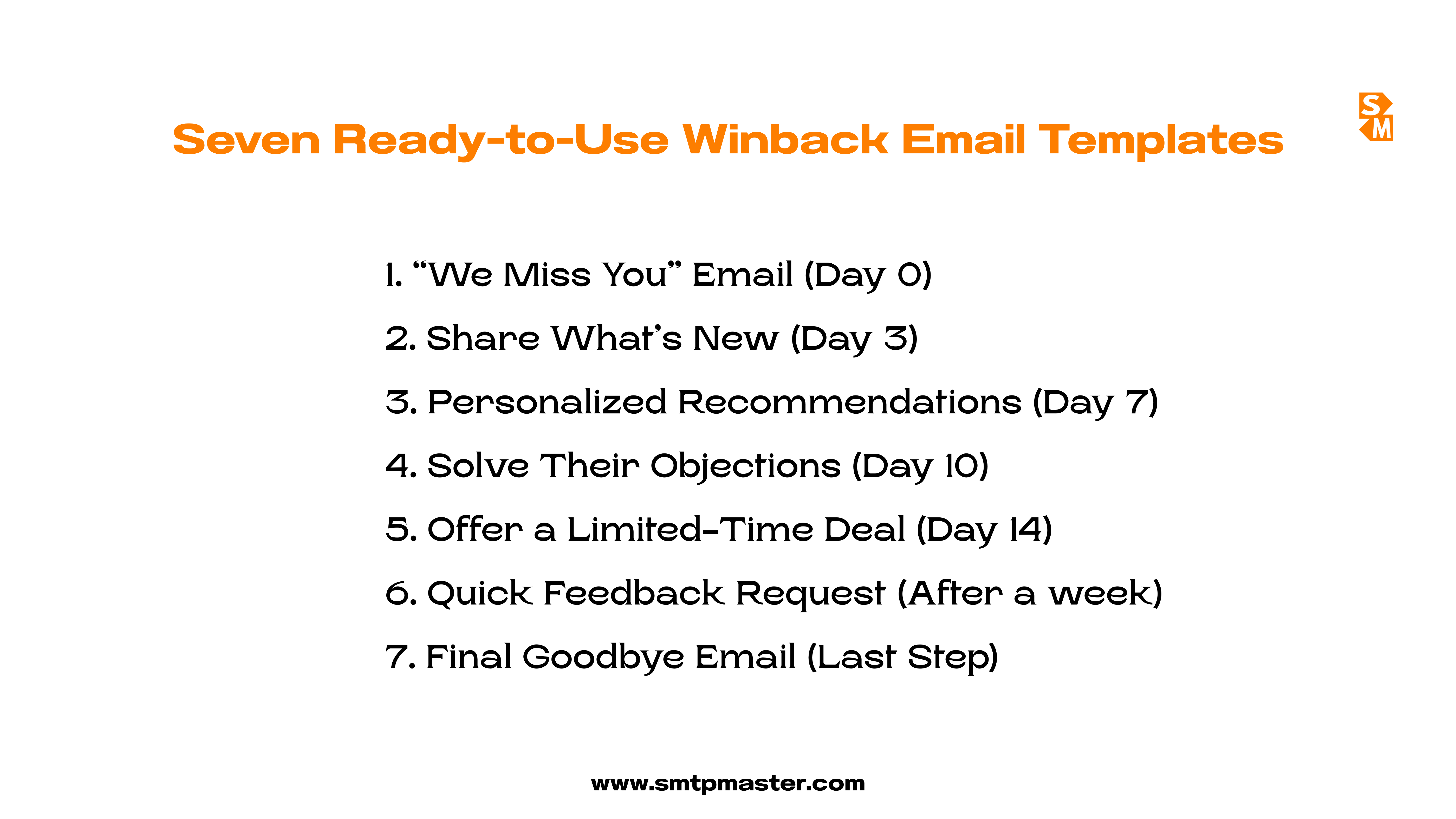
Here are 7 effective winback email ideas to help you re-engage inactive subscribers and rebuild their interest in your brand
1. “We Miss You” Email (Day 0)
Goal: Warmly re-engage inactive users.
Subject ideas: “We saved your spot” | “Still here when you’re ready”
Send a short, friendly reminder that shows you noticed their absence. Keep it positive and include one clear call-to-action (CTA) — like “Come back and explore.”
2. Share What’s New (Day 3)
Goal: Highlight updates and improvements.
Subject: “See what’s new since your last visit”
Show them what’s changed — new features, popular products, or customer favorites. This gives them a reason to return and see what they’ve been missing.
3. Personalized Recommendations (Day 7)
Goal: Make it feel personal and relevant.
Subject: “Recommended just for you”
Use browsing or purchase history to share 2–3 products or services they might love. Personal touches make the message feel authentic and tailored, not automated.
4. Solve Their Objections (Day 10)
Goal: Address reasons why they stopped engaging.
Subject: “We’ve fixed what you asked for”
Tackle common concerns like pricing, shipping delays, or missing features. Show that you’ve listened and improved. It’s a great way to rebuild trust and interest.
5. Offer a Limited-Time Deal (Day 14)
Goal: Add urgency and motivation.
Subject: “Your special offer ends soon
Create a sense of urgency with a short-term offer — a discount, free trial extension, or free shipping. Keep it simple and make sure the offer feels genuine, not desperate.
6. Quick Feedback Request (After a week)
Goal: Learn why they drifted away.
Subject: “Can you tell us what went wrong?”
Ask for quick feedback through a short one-question survey. Offer a small thank-you — like a discount code or store credit — to encourage participation and goodwill.
7. Final Goodbye Email (Last Step)
Goal: End on a polite and respectful note.
Subject: “Should we stop emailing you?”
Let them decide if they want to stay on your list or move to a low-frequency newsletter. A kind, transparent message can leave a lasting positive impression, even if they opt out.
Writing and Design Tips
Good design and clear writing can make your winback emails far more effective. Keep these tips in mind:
Stay focused: Share one message and one strong call-to-action (CTA) per email.
Sound human: Use a friendly, conversational tone instead of a hard-sell approach.
Add personalization: Include the recipient’s name or last purchase for a personal touch.
Keep it simple: Use a clean design that looks great on mobile and loads quickly.
Be transparent: Always add a clear unsubscribe link.
A short, friendly, and well-designed email is all it takes to win your customers back.
Track the Right Results
Track key numbers: Check your open rates, click rates, purchases, replies, and unsubscribes to see how people are engaging.
Know what’s normal: On average, around 10–20% of inactive users re-engage, and 3–8% make a purchase after a winback campaign.
Keep improving: Test different subject lines, offers, send times, and message styles to see what connects best with your audience.
Consistent tracking and small adjustments can turn your winback flow into a reliable source of reactivated customers.
Conclusion
Bringing back lost customers doesn’t have to be complicated — it just takes the right message at the right time. A well-crafted winback email sequence helps you reconnect with people who already trust your brand, reminding them why they chose you in the first place. Start small, personalize every touchpoint, and keep your tone warm and genuine. With consistency and care, your winback flow can turn quiet subscribers into loyal, long-term customers once again.
FAQ
Q1. When should I send winback emails?
Send them after 30–90 days of customer inactivity, depending on your business type.
Q2. How many emails should be in a winback sequence?
Typically 3 to 5 emails spaced over one to two weeks work best.
Q3. How can I tell whether my winback emails are effective?
Track open rates, clicks, conversions, and unsubscribe rates to measure success.
Q4. Should I include discounts in every winback email?
No, offer discounts only in later emails to encourage final conversions.
Q5. Why are winback emails important for businesses?
They help recover lost customers cost-effectively and boost long-term loyalty.